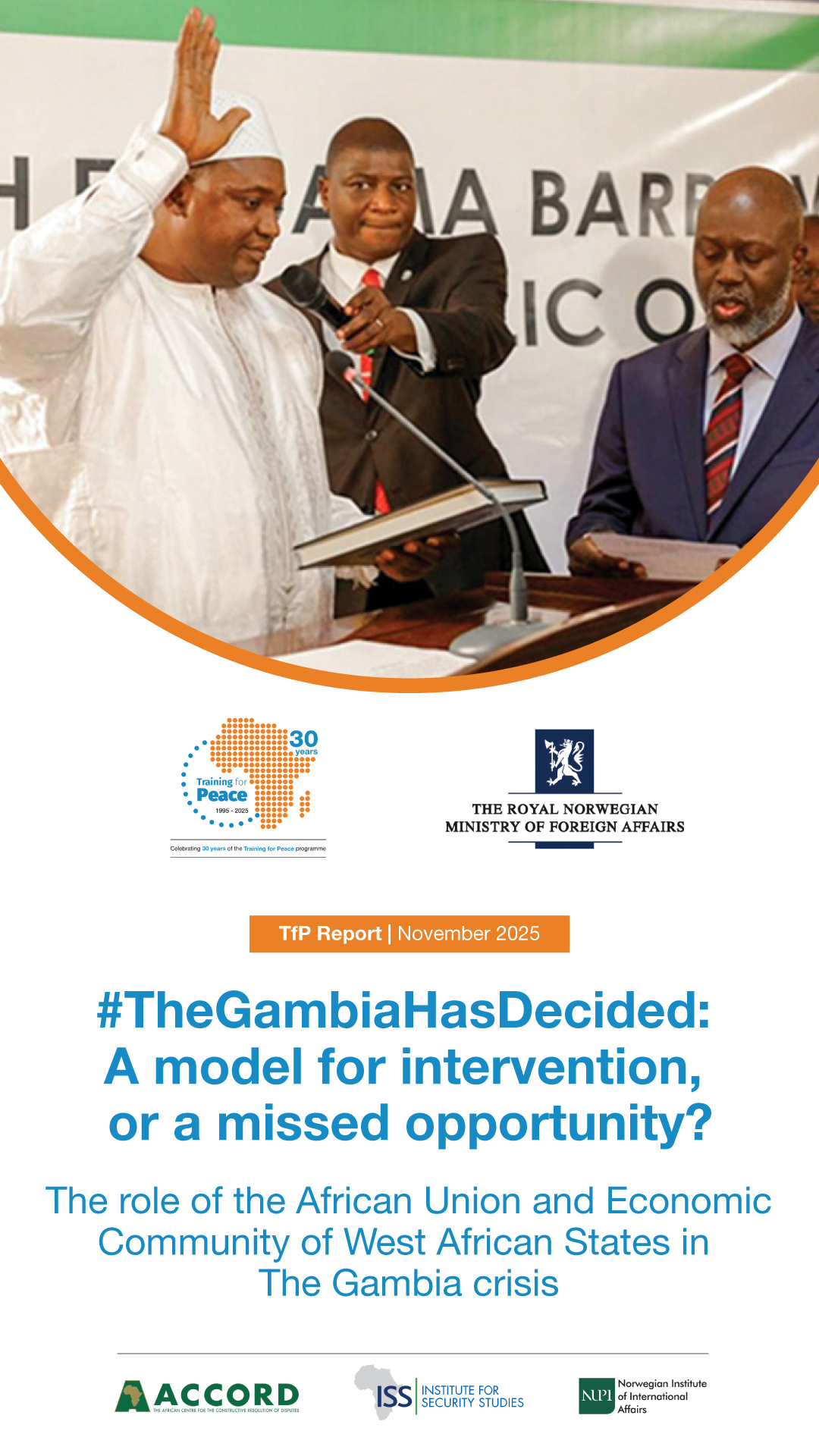
Recent years have seen increased instances of democratic backsliding across West Africa, particularly through military coups. This
Community of West African States (ECOWAS), in collaboration with the African Union (AU), can work proactively together to strengthen democratisation processes.
Against this backdrop, this report presents an in-depth case study on The Gambia. In particular, it evaluates the AU- and ECOWAS-led interventions that followed the country’s elections in 2016. In the course of its assessment, the study articulates insights for Africa-led interventions. These draw on an array of tools, including mediation, political missions and military pressure. Another key focus of the report is the changing nature of partnerships between the AU and regional economic communities (RECs) as part of their responses to political crises. This includes examining the extent to which the AU and ECOWAS coordinated efforts to address the constitutional crisis that followed the disputed outcome of the December 2016 polls.
The study culminates in a series of key findings. Among these is that the principle of subsidiarity remains ambiguously defined; that coordination between the AU and ECOWAS was uneven and at times duplicative; and that national ownership in The Gambia was insufficiently embedded in the reform process. This suggests that while ECOWAS´ visible and robust intervention was decisive in restoring constitutional order, the AU´s more technical engagement lacked visibility and sustainability. Both actors struggled to align their support in a coherent and mutually reinforcing manner. Over time, this served to reduce how both organisations were able to act as continuous and legitimate actors in the country.
These findings offer guidance on how the AU and RECs could partner more effectively to address crises in Africa. Clarifying subsidiarity is a key step. While the term is widely used by the AU and RECs, the key questions of subsidiarity — such as the political dimensions it entails; and how the AU and ECOWAS could jointly address a lack of political will at the member state level — remain unresolved.
Other areas of guidance defined in the report include strengthening joint planning and communication; and ensuring that balanced attention is given not only to immediate security concerns, but also longterm governance reform. The study concludes that without deeper institutionalised coordination mechanisms and stronger political will from both continental and national actors, the sustainability of such interventions will remain limited.